.png)
15-18 October 2026
15-18 October 2026
Discovery
%2C%202026%2C%20Mild%20steel%2C%20207%20x%2071_edited.jpg)
This sculptural work "First impulse (Erster Impuls)" by Wong Perng Fey captures the fleeting moment before movement—the instant when an impulse becomes action. Suspended between stillness and momentum, it explores the tension between spontaneous reaction and deliberate calculation. The work evokes the energy of crossing a threshold, where intention, anticipation, and the desire to move converge in a single decisive moment.
Wong Perng Fey (b.1974, Kuala Lumpur, Malaysia) is a multidisciplinary artist whose practice explores permanence, change, and memory through painting. His work draws on overlooked traces of human presence in living spaces, including graffiti, wall scratches, and remnants of rooms revealed through urban demolition. Encountered across different cities, these fragments evoke nostalgia and belonging, inspiring the artist to capture the emotions, memories, and histories embedded within familiar yet transient spaces.
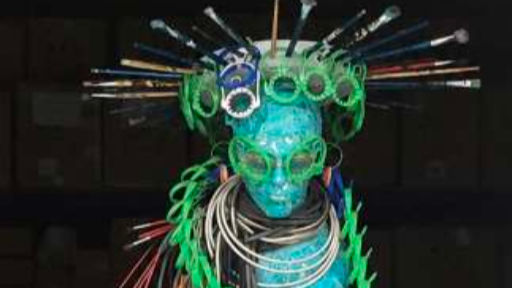
Constructed from discarded electrical cables, plastic waste, household objects and recycled materials, this human-like figure examines the relationship between waste and human behaviour. Part of the artist’s Reflection of the Human Mind series, the installation transforms discarded objects into a new identity, challenging perceptions of what constitutes “rubbish.” More than an environmental statement, the work reflects on everyday choices and responsibility, reminding us that caring for the Earth begins with awareness, thoughtful disposal and changing how we think.
Phillip Wong (b. 1968, Seremban, Malaysia) is a contemporary artist, curator, and arts advocate whose multidisciplinary practice spans painting, installation, and transparent painting on glass and perspex. Exploring the human mind, spirituality, emotion, and humanity’s relationship with nature, Wong has exhibited internationally and received recognition including the Grand Prize at the Asia Art Award in Seoul (2007).

When We Touch the Floor by Mok Yee explores the intimate relationship between the body and the floor through tikar getah, a familiar flooring material across Southeast Asian domestic and communal spaces. Combining video, sound and scent, the installation reflects on how everyday gestures—sitting, squatting, lying and resting—are shaped by climate, material and architecture. The work invites us to reconsider the floor as an active site where bodily habits, memory and everyday life unfold.
Concept and performance: Lee Mok Yee
Videography and editing: Low Pey Sien
Sound and Music: Teo Wey Yinn
Production assistant: Doris Quek
Supported by Filamen
In conversation with Dr. Noramin Farid
Lee Mok Yee (b. 1988, Klang, Malaysia) is a Kuala Lumpur-based visual artist working across sculpture, installation, video, and performance. His practice explores material culture, ritual, labour, and place through ordinary and found objects. Drawing from Chinese Southeast Asian material cultures, his work examines social and cultural narratives. He received the UOB Painting of the Year (Malaysia) Gold Prize in 2021 and exhibits internationally.

Yield is a series of kinetic sculptures made from compressed salvaged laptops sourced in Malaysia, resembling silver foliage from afar but revealing discarded hardware up close. The work connects electronic waste to the material realities of AI, challenging its seemingly weightless existence. Drawing on Malaysia’s semiconductor industry and the Taoist Celestial Court, it reflects on technological inheritance and asks what values we embed in AI as we shape the descendants we are creating.
Samantha Lee (b.1993, Malaysia) is an artist and technologist working across video, sculpture, installation, and computational systems. Her practice explores how technology shapes perception, memory, and selfhood. Interested in absurdity, fractured memory, and technological mediation, Lee examines how culture and identity emerge through repetitive acts of scrolling, imitation, and staging.

Disambiguate, central to The Shape of Obedience, explores rebellion, dissociation, and self-preservation through a figure concealed by thorns and a glowing cloud. The work critiques conformity and the psychological costs of social expectations, where the thorned form becomes a defence against external pressure. Hidden beneath it, the self resists the demand to obey.
Alexdrina Chong (Alexoid Luce) (b.1977, Malacca, Malaysia) is a Malaysian multidisciplinary artist, designer and author working across sculpture, visual design and psychological advocacy. Founder of So+Co (Social + Collaboration), she explores mental health, emotional complexity and social expectations through visual storytelling and material experimentation, blurring boundaries between art, design, illustration and literature.
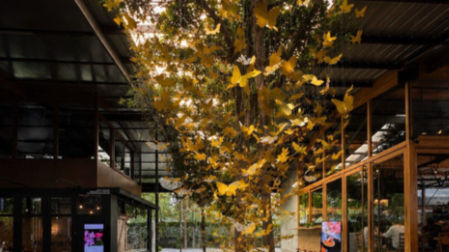
What Remains Possible is an immersive installation that reflects on hope as an enduring possibility rather than a certainty. Suspended among the branches of a living tree, golden butterflies evoke transformation, resilience, and the quiet potential for renewal, inviting visitors to pause and imagine futures yet to unfold.
Najib Ahmad Bamadhaj (b.1987, Muar, Johor) is a Malaysian artist whose practice explores society and politics through paintings depicting women, animals, flowers, and natural scenery. A UiTM Fine Art graduate, he co-founded TOKO ART, founded Ruang Bamadhaj, and is a member of RUMPUN. His work has been exhibited internationally.

This work explores the accumulation of voices, ideas, and ideologies that surround us. Hundreds of porcelain spoons move within rounded frames, creating a soundscape that shifts from gentle rhythm to overwhelming noise. It asks when communication becomes noise, whose voices we elevate, and whether we question the ideas and certainties we inherit.
Neoh Shin Yen (b.1987, Penang, Malaysia) is a Malaysian contemporary artist whose practice explores themes of memory, place, and lived experience through painting and mixed-media works. Drawing from personal observations and everyday encounters, Neoh investigates the relationship between individual narratives and broader social landscapes. The artist has participated in exhibitions across Malaysia and internationally, and continues to live and work in Penang, Malaysia.

In Farhan Rizuwan’s installation of multiple chairs, the chair becomes a symbol of position, carrying traces of the body while withholding the body itself. Through repetition and absence, the work reflects how identity is perceived, assumed, and judged. The installation explores the tension between presence and absence, visibility and interpretation, and the weight of expectation.
Farhan Rizuwan (b.2002, Kedah, Malaysia) is a Malaysian sculptor whose practice reimagines everyday furniture, particularly chairs, as poetic sculptural forms. Deconstructing and reconstructing familiar objects, he explores anthropomorphism, human identity, and emotional experience. His sculptures evoke bodily gestures, postures, and psychological states, transforming functional objects into metaphors of presence, lived reality, and human existence.